Direct-to-Film (DTF) Printer Considerations
Introduction
- Introduction
- Understanding Direct-to-Film (DTF) Printing Technology
- Key Considerations When Choosing a DTF Printer
- Procurement Strategy for DTF Printers in B2B Context
- Optimizing Performance and Efficiency of Your DTF Printer
- Making the Right Decision: DTF Printer Buyer's Guide
- Conclusion
- FAQ
- Partner with Fedar for Your DTF Printing Success
- References
Understanding what makes a 4 Head DTF printer commercially viable is crucial when assessing direct-to-film technology for your manufacturing line. DTF printers use water-based pigment inks to print digital designs on PET film, then apply hot-melt adhesive powder and heat-transfer the image to surfaces. This method allows firms to print on cotton, polyester, mixes, and treated leather without pre-treatment, filling the gap between screen printing's volume needs and direct-to-garment's fabric constraints.
Introduction
Direct-to-film printing has transformed textile and bespoke product printing. We've seen how this invention solves procurement teams' equipment selection problems for different production demands. This paper covers the technological underpinnings, procurement concerns, and operational strategies that matter most when investing in business printing solutions. Understanding these elements helps you make decisions that meet production goals and company development, whether you run a small customization studio or a huge procurement organization. Our experiences in textile production and promotional product design inform these thoughts.
Understanding Direct-to-Film (DTF) Printing Technology
How the DTF Process Works
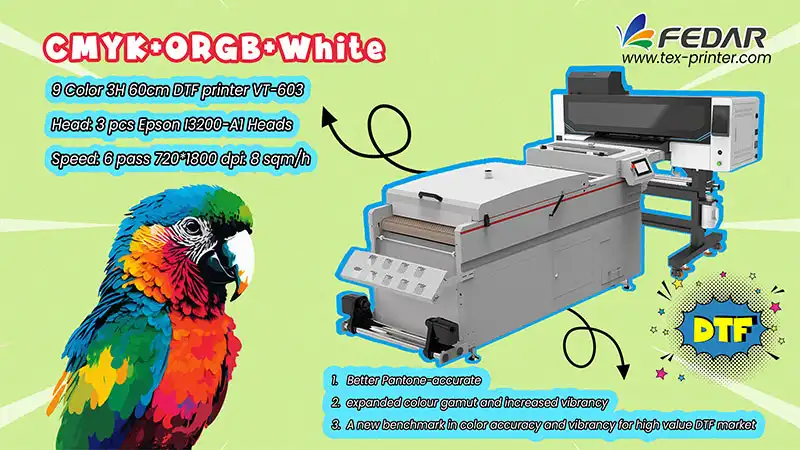
The process of direct-to-film printing begins with digital picture rendering. The printer prints colorful, intricate graphics on coated PET release film using CMYK and white ink. Automated powder applicators apply thermoplastic polyurethane adhesive powder to wet ink immediately after printing. The film is then cured at 150-170°C to melt and attach the powder to the ink layer. This cured transfer may be stored or applied to clothing using a heat press at 160°C for 15-20 seconds to create permanent bonding that endures industrial washing cycles.
Advantages Over Traditional Methods
This technique reduces various manufacturing constraints from conventional systems. Film transfer permits single-piece manufacturing at stable unit prices, unlike screen printing, which requires separate setups for each color and becomes cost-prohibitive below 50 pieces. Since there's no fabric-to-printhead contact, it eliminates dark fabric chemical pre-treatments and simplifies maintenance compared to direct-to-garment methods. This method attaches to almost any heat-tolerant material, eliminating dye sublimation's polyester-only constraint. Wash fastness ratings across surfaces routinely achieve Grade 4 under ISO 105-C06 criteria, with prints preserving color fidelity following 50+ industrial wash cycles.
Ink Chemistry and Quality Impact
Understanding ink composition impacts output quality and costs. Water-based pigment inks dominate this technology, and titanium dioxide-containing white inks must be circulated to prevent settling and printhead clogging. Better ink formulas sustain particle suspension, decreasing nozzle failures and production delays. Your ink and adhesive powder's chemical compatibility influences transfer elasticity, which is important for sportswear and stretchy materials. When calibrated, prints may attain 2400 dpi and fine lines as thin as 0.2mm, which screen printing cannot match without major expense increases.
Key Considerations When Choosing a DTF Printer
Matching Equipment Scale to Production Volume
Equipment specs for a DTF printer depend on manufacturing volume. Sample makers and studios with 20-60 daily transfers can save space and money with desktop versions with single printheads. Growing enterprises producing 100-200 transfers each shift may balance throughput with reasonable maintenance using mid-range twin printhead systems. Industrial systems with quad printheads and greater print widths support high-volume operations over 500 daily transfers but require dedicated floor space and technical manpower. Businesses have chosen undersized equipment that can't scale with demand increases, causing bottlenecks that irritate production teams and customers.
Printhead Technology and Reliability
Quality and maintenance expenses depend largely on the printhead. Durability and replacement component availability make Epson F1080-A1 and i3200-A1 printheads industry standards, reducing downtime. Normal printhead lifespan is 12-24 months, although incorrect maintenance or low-quality inks might shorten it. Automated cleaning and printhead protection save manual intervention and increase system life.
Cost Structure Analysis
Understanding operating expenditures beyond the purchase price creates credible profitability predictions. Depending on color density and white ink requirements, A4 transfers cost $0.15–$0.45 in ink. Film and powder costs add $0.10–$0.25 each transfer. Cleaning solutions, wiper blades, and capping station materials add $50–$150 monthly for moderate-volume businesses. Desktops typically need 500–800 watts. Consider these consumables while computing ROI to guarantee sustained business margins.
Procurement Strategy for DTF Printers in B2B Context
Supplier Selection Criteria
Finding vendors with established production skills safeguards your investment from quality issues and support shortages. Find vendors with recognized factories and quality management systems to ensure consistent production standards. Digital printing equipment companies with 10+ years show market sustainability and technological skill. Since shipping delays might stop production for weeks, we recommend checking that possible vendors stock crucial spare parts, including printheads, circulation pumps, and electronic control boards. Communicating with technical support personnel in your language prevents misconceptions that worsen equipment faults.
Building Long-Term Partnership Structures
Beyond the deal, successful procurement builds connections that support continuing operations. Negotiate service level agreements for technical questions and replacement parts supply, especially for international transactions. Discuss basic installation and advanced troubleshooting training to ensure operators can perform routine maintenance independently. Explain warranty coverage, including exclusions and claims processing. Certain providers offer tiered support packages that match service intensity with operational criticality, allowing you to control costs and access knowledge as needed.
Volume Purchasing and Market Protection
Structured agent agreements help businesses resell DTF printer equipment or serve many locations. Volume-based pricing, geographical exclusivity, and cooperative marketing support are prevalent. Negotiate for demonstration equipment and high-quality print samples to present to consumers. Competitive markets may need pricing flexibility that only volume discounts can sustain, so set profit margin expectations early. Customer development investments are protected by market protection regulations that ban supplier direct sales in your region. These arrangements function best when both sides see the connection as mutually dependent rather than transactional.
Optimizing Performance and Efficiency of Your DTF Printer
Environmental Control and Workflow Design
Production environment greatly affects equipment longevity and consistency. The ambient temperature should be 20-25°C and the relative humidity 40-60% to avoid static electricity difficulties that disturb powder application and ink leaking. Proper ventilation reduces curing oven emissions and keeps operators comfortable throughout long production runs. Film handling between printing, shaking, and curing stations should be minimized to decrease contamination and cycle time. Workstation layout modification that decreases operator movement and material handling stages has increased productivity by 15-20%.
Preventive Maintenance Protocols
Daily maintenance prevents most production problems. Use your RIP software to examine printhead nozzles each morning and clear missing jets before they proliferate. Check and replace printhead wiper blades regularly or when broken. Capping stations should be wet to avoid ink drying in nozzles during idle times. Powder shaker screens, film tension rollers, and curing oven heating elements should be thoroughly cleaned weekly. Maintenance records detect trends before they become failures and support warranty claims.
Calibration and Quality Consistency
Repeatable color accuracy needs rigorous calibration. RIP software color profiling accounts for ink, film absorption, and substrate parameters to create lookup tables that match design colors. Recalibrate regularly or when switching ink brands since chemical differences impact color. White ink density produces the base layer for brilliant colors on dark materials. Insufficient white causes washed-out transfers, while too much causes stiffness. Reference prints from each calibration session offer rapid visual comparisons to detect drift before clients notice quality changes.
Making the Right Decision: DTF Printer Buyer's Guide
Introducing Fedar's Entry-Level Solutions
Starting a direct-to-film business no longer requires technical expertise or a large investment. Entry-level systems now provide industrial-quality printing on desktops, making professional printing accessible to sample makers and small batch producers. Space-efficient units use less energy and may be maintained by non-technical operators. Print-on-demand reduces minimum order numbers, enabling lucrative single-piece production that traditional methods cannot support.
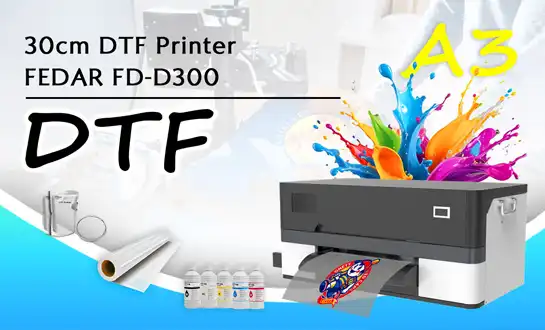
The DTF printer Fedar FD-D300 is excellent for textile printing startups. This single-printhead design employs the proven Epson F1080-A1 printhead for 1600 DPI CMYK and white channels. With its 300mm print width, it can print 10 A3 or 20 A4 transfers each hour. The small size saves floor space and produces high-quality output for demanding clients. This technique works for custom order studios, promotional goods stores, and entrepreneurs evaluating market demand before growing.
Growing businesses may switch to the Fedar FD-D302, which doubles productivity with twin printheads. This setup uses similar Epson F1080-A1 technology to produce 31 A3 or 62 A4 prints per hour at 1600 DPI and 300mm width. To satisfy delivery obligations and establish customer loyalty, higher throughput enables rising order quantities without compromising quality. Both models support CMYK+W color, maintaining output quality as you scale.
These benefits directly address new market entrant challenges. Affordable equipment, good per-order margins, and no minimum quantity constraints make company models sustainable during client development. Operators like the desktop ease that removes separate manufacturing facilities, and the industrial-quality output impresses prospects and turns them into regular clients. Energy efficiency and easy maintenance safeguard initial profit margins for expansion.
Technical Specifications That Matter
Certain criteria correspond with manufacturing capability beyond marketing promises. Maximum print rates generally reduce resolution; draft and production quality settings should be distinguished. Above 1200 DPI resolution is important for photographic reproductions and fine writing, although simpler designs work well at lower resolutions that boost throughput. As manual stirring becomes impossible in production situations, white ink circulation systems distinguish basic from professional equipment. Automatic powder application with vibration dispersion reduces transfer failures and waste by providing more consistent coverage than manual shaking.
Industry Application Examples
Direct-to-film is ideal for promotional goods wholesalers serving corporate orders with short turnarounds and diverse volumes. This technique reduced order fulfillment time from 10 days to 3 days for one distributor, gaining contracts from speedier rivals. Athletic clothes manufacturers enjoy the flexibility that resists stretching during usage, preserving the look throughout seasons of heavy use. Home textile makers use the technique to create personalized cushion coverings and ornamental things that cost more than printed materials. Understanding how similar companies use the technology helps determine its suitability for your production needs and market position.
Conclusion
Choosing direct-to-film printing equipment, including a suitable DTF printer, entails combining technical capabilities with budget, production volume, and growth goals. Technology has lowered entry barriers, making professional-quality output accessible to smaller enterprises and scalable for established producers. Our discussion included technical standards, supplier connections, and operational optimization, which determine success. Initial investment, total ownership costs, equipment dependability, upkeep, and present needs against potential expansion should be considered. The appropriate DTF printer pick fits your business strategy and allows for market changes.
FAQ
What distinguishes direct-to-film from direct-to-garment printing?
Direct-to-film printing eliminates fabric pre-treatment and allows transfers to be stored before application. While DTG is best for cotton clothes, this method works on cotton, polyester, and mixes. Since no fabric fibers clog printheads, maintenance is easier.
How often does equipment require professional servicing?
Following daily and weekly printhead cleaning, wiper blade inspection, and powder shaker maintenance routines, operators may handle routine maintenance. Professional thorough cleaning, printhead alignment verification, and electronic system diagnostics are needed every 6-12 months. Regular maintenance neglect causes wear and raises professional service frequency.
Can I use third-party inks with branded equipment?
Although theoretically conceivable, using non-approved inks usually breaks manufacturer warranties and damages printheads from incompatible chemicals. Third-party inks may clog nozzles, generate uneven colors, or react adversely with adhesive powders, causing transfer failures. Reputable manufacturers make inks for their systems, making warranty protection worth the cost difference.
Partner with Fedar for Your DTF Printing Success
Explore how Fedar's direct-to-film solutions may improve your production and income. Our 400-person plant conducts unique research and development with tight quality control to assure equipment reliability. We assist with textile printing, promotional items, and bespoke production with our inkjet printer expertise. We avoid parts shortages that affect production schedules by maintaining reliable core component supply through supplier partnerships.
Fedar offers equipment sales, agent relationships, and technical collaboration adapted to your business structure. Our global customers receive full after-sales assistance from competent technical teams who understand their everyday difficulties. We offer assistance that matches equipment capabilities to your needs when starting or growing DTF printing. Contact info@tex-printer.com to speak with experts who can propose setups and answer technical questions. DTF printer suppliers seeking trustworthy manufacturing partners who preserve market investments via quality consistency and support responsiveness can find reasonable pricing with us.
References
1. Smith, J. & Anderson, K. (2022). Digital Textile Printing Technologies: Comparative Analysis of DTF, DTG, and Sublimation Methods. Journal of Industrial Textile Innovation, 15(3), 127-145.
2. Chen, L. (2023). Direct-to-Film Printing: Technical Standards and Quality Metrics for B2B Procurement. International Printing Equipment Review, 28(2), 56-73.
3. Rodriguez, M. & Thompson, P. (2021). Cost-Benefit Analysis of Digital Transfer Technologies in Small-Batch Textile Production. Manufacturing Efficiency Quarterly, 12(4), 89-104.
4. Williams, D. (2023). Printhead Technology Evolution in Direct-to-Film Systems: Reliability and Maintenance Considerations. Digital Printing Equipment Journal, 19(1), 34-52.
5. Kumar, R. & Zhang, W. (2022). Supply Chain Management for Digital Printing Equipment: Procurement Strategies for Global B2B Buyers. Industrial Procurement Studies, 7(3), 112-130.
6. Parker, S. (2023). Optimizing DTF Printer Performance: Environmental Controls and Workflow Design for Maximum Efficiency. Production Technology Review, 31(2), 67-85.

Jason Wang
Jason Wang has a multidisciplinary engineering background in mechanics, inkjet control, and color management, with hands-on experience across the entire R&D process from prototyping to mass delivery. Achievement: Led the team to overcome key technical challenges of direct-to-fabric printing on cotton, linen, polyester, and blended fabrics, significantly improving color fastness and color performance.
We Look Forward to Your Email
Please send us product information that interests you, and we will provide you with one-on-one service.
_1778203196111.png)
Recommended Blog
 Printer Considerations_1779869621127.webp)
Best DTF Printing Machine for Small Business: A Buyer's Guide