How Does a 600mm DTF Transfer Printer Improve Productivity?
What Is a 600mm DTF Transfer Printer?
- What Is a 600mm DTF Transfer Printer?
- Understanding the 600mm DTF Transfer Printer Technology
- Identifying Productivity Bottlenecks in Traditional Printing Methods
- How the 600mm DTF Transfer Printer Optimizes Production Workflow
- Comparing 600mm DTF Transfer Printers With Alternative Solutions
- Procurement and Support Considerations for B2B Buyers
- Conclusion
- FAQ
- Ready to Scale Production With a 600mm DTF Transfer Printer?
- References
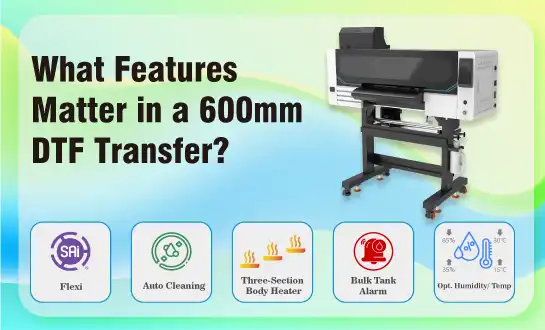
A 600mm DTF transfer printer speeds up production by making the print area bigger, adding more printheads, and automating the handling of powder so that workers don't have to do as many steps by hand between print runs. This type of equipment bridges the gap between the ability to make samples and the actual number of market orders for companies and agencies that want to use more than small desktop DTF units. This article breaks down where traditional printing methods waste time, how a wider-format machine can fix those problems, and what people should look for before adding one to their factory floor.
To go beyond what a PC can do, you shouldn't have to guess at the system specs. Fedar makes the FD60, FD604, and FD606 600mm DTF transfer printers in a plant with 400 workers that was designed to make sure the quality of the output is always the same. Anyone who wants to ask directly about pricing or configuration can email info@tex-printer.com at any time.
What Is a 600mm DTF Transfer Printer?
A 600mm DTF transfer printer is a roll-to-roll direct-to-film printer with a 600mm print width. It is designed to print at high speeds in long runs instead of on single sheets. Multiple printheads work together to print CMYK and white pigment ink onto PET film. The film is then fed into automated powder and curing stages.
This format isn't like small personal DTF printers that are made to print single sheets; it's made for medium-scale production, with output high enough to meet the needs of both wholesalers and factories without having the space or cost of an industrial-scale system. There are usually two-head, four-head, or six-head configurations, and each one adds output at a different cost.
Understanding the 600mm DTF Transfer Printer Technology
What makes the printhead configuration matter for output speed?
Printhead count directly determines how many ink passes a machine can complete simultaneously across the film width. A 600mm DTF transfer printer using dual Epson I3200-A1 heads handles one ink pass configuration, while four-head or six-head models split the workload across more nozzles at once.
The Epson I3200-A1 printhead itself uses PrecisionCore MicroTFP technology with 3,200 nozzles arranged across 8 rows, delivering native 600 dpi resolution per channel [1]. This nozzle density is why the printhead has become a common choice across large-format DTF equipment, balancing speed with consistent image quality.
How does roll-to-roll feeding change the workflow compared to sheet-fed printers?
Roll-to-roll feeding on a 600mm DTF transfer printer lets film move continuously through printing, powdering, and curing stages without an operator manually loading each sheet. This matters most for factories running long production batches, where sheet-by-sheet loading adds up to significant labor time across a full shift.
Continuous feeding also reduces the risk of misalignment between print runs, since the film path stays consistent rather than resetting with every new sheet insertion.
Why does white ink circulation matter more on wider-format machines?
White ink pigment settles faster than CMYK due to heavier titanium dioxide particles, and that settling problem compounds across a wider printhead array. A 600mm DTF transfer printer without automated white ink circulation risks uneven opacity across the full print width, showing up as visible banding on finished transfers.
Built-in circulation systems keep pigment evenly suspended throughout a production run, which matters considerably more at 600mm width than on a compact 300mm desktop unit covering a smaller area.
Identifying Productivity Bottlenecks in Traditional Printing Methods
Where does screen printing lose the most time on mid-volume orders?
Screen printing requires a dedicated screen for every color in a design, and setting up multiple screens for a multi-color job can take hours before the first garment even prints. Grand View Research reports that dedicated DTF printers held the largest market share, at 45.0%, of the direct-to-film printing market in 2024 [2], reflecting how many businesses have shifted away from screen setup time toward film-based workflows.
For orders in the hundreds-of-units range, that setup time eats directly into delivery deadlines, especially when a factory is juggling multiple design changeovers in a single day.
Why do compact desktop DTF printers struggle at higher order volumes?
Desktop-format DTF printers, often sized around 300mm print width, work well for sample-making and small studios but hit a throughput ceiling once order volume climbs, which is often the point where factories start evaluating a 600mm DTF transfer printer. A single-printhead desktop unit processing roughly 10 A3 sheets per hour simply can't match the pace a factory needs for bulk wholesale fulfillment.
Manual powder application and shaking also slow desktop workflows down, since operators handle each printed sheet individually rather than relying on automated powder stations built into wider production equipment.
What hidden costs come from inconsistent color reproduction?
Color inconsistency between batches forces reprints, wasting film, ink, and labor hours that a factory can't recover. One market analysis notes that ink and film quality variability directly impacts print durability, color vibrancy, and adhesion to fabrics [3], a problem that gets more expensive to fix at scale than on a single small-batch order.
How the 600mm DTF Transfer Printer Optimizes Production Workflow
How does auto powder shaking reduce labor time?
Automated powder shaking and curing stations built into a 600mm DTF transfer printer remove one of the most labor-intensive manual steps in traditional DTF workflows. Instead of an operator shaking excess powder off each individual sheet, the film moves through an integrated shaking and curing module continuously.
This single automation point frees up staff to handle design setup, quality checks, or finishing work instead of repetitive manual powder handling across every printed meter of film.
What throughput improvement can factories realistically expect?
Throughput scales directly with printhead count on this equipment class. The dual-head FEDAR FD60 produces roughly 8 square meters per hour at 6-pass CMYK settings, while the four-head FEDAR FD604 roughly triples that to around 24 square meters per hour, matching the pace of the six-head FEDAR FD606 configuration at comparable settings.
- Dual-head configuration (FD60): Suited to medium-scale operations balancing output against equipment footprint and upfront investment, producing around 8m²/hour.
- Four-head configuration (FD604): Fits factories needing roughly triple the throughput of a dual-head setup without stepping up to the largest available footprint, reaching approximately 24m²/hour.
- Six-head configuration (FD606): Matches the four-head model's throughput at comparable settings while offering additional redundancy, useful for factories running near-continuous production shifts.
How does compact industrial design affect factory floor planning?
A 600mm-class 600mm DTF transfer printer occupies less floor space than full industrial-scale wide-format systems, letting medium-sized factories and advertising shops add DTF capacity without a major facility overhaul. This compact footprint matters for shops transitioning from desktop units to production-scale equipment for the first time.
Comparing 600mm DTF Transfer Printers With Alternative Solutions
How does this equipment compare against desktop DTF printers and screen printing?
| Factor | 600mm DTF Transfer Printer | Desktop DTF Printer | Screen Printing |
|---|---|---|---|
| Typical throughput | 8-24 m²/hour | ~10 A3 sheets/hour | Fast once screens are ready |
| Setup time per design | Minimal, digital file swap | Minimal | Hours (screen creation) |
| Best fit | Medium-scale factories, wholesale orders | Sample makers, small studios | Large single-design runs |
| Powder handling | Automated | Manual | Not applicable |
| Footprint | Compact industrial | Small/desktop | Large (screens, curing racks) |
When does upgrading from desktop to 600mm equipment make financial sense?
Studios consistently filling batch orders beyond what a single desktop printhead can process within delivery windows typically see the clearest return from upgrading. The direct-to-film printing market was valued at USD 2.72 billion in 2024 and is projected to reach USD 3.92 billion by 2030, growing at a 6% compound annual rate [4], a trend that reflects rising order volumes many small studios are scaling into.
Agents should weigh a customer's current order volume against realistic near-term growth before recommending a jump straight to a six-head 600mm DTF transfer printer configuration, since matching capacity to actual demand protects the customer's return on investment.
Procurement and Support Considerations for B2B Buyers
What factory credentials should agents verify before recommending this equipment?
A 400-person factory specializing in original R&D and production with strict quality control gives agents a documented answer when factory owners or technical directors ask about manufacturing consistency behind a 600mm DTF transfer printer. Factories deeply rooted in the inkjet printer market, rather than treating DTF as a side product line, tend to maintain steadier core component supply chains.
Unstable sample quality remains one of the most common reasons agents struggle to convert prospects, so requesting reproducible sample runs on the exact configuration being considered protects both the agent's reputation and the end customer's investment.
Why does cross-border after-sales support matter more at this equipment tier?
No installation, repair, or spare parts support for cross-border business becomes a bigger risk at the 600mm production tier, since downtime on a factory-scale machine affects far more order volume than a single desktop unit going offline. A brand with a strong after-sales support team and flexible cooperation models reduces that exposure meaningfully.
Agents should confirm installation support specifically, since a 600mm DTF transfer printer with roll-to-roll feeding and multiple printheads typically requires proper setup and calibration that a factory's own technical staff may not handle confidently without vendor guidance.
What questions reveal whether pricing reflects genuine value?
Ask what's included beyond the base unit: installation support, technical training, spare parts availability, and market protection terms for agent territories. Competitive pricing paired with a reasonable profit margin only holds up over time if maintenance costs and downtime stay low, which depends heavily on component quality and factory-backed reliability rather than sticker price alone.
Conclusion
A 600mm DTF transfer printer closes the productivity gap between desktop sample-making and full industrial-scale production, using wider print width, multiple printheads, and automated powder handling to cut manual labor time. Matching printhead configuration to real order volume, and backing that equipment with a manufacturer offering genuine cross-border support, determines whether the upgrade actually protects margins. For agents and factory buyers, that combination of throughput fit and dependable partnership matters more than chasing the highest headline speed.
FAQ
How many printheads do I need for a mid-size printing factory?
It depends on daily order volume. A four-head configuration suits most mid-size factories needing roughly triple desktop output, while a six-head setup adds redundancy for near-continuous production shifts rather than dramatically higher raw speed.
Does a 600mm DTF transfer printer require special installation?
Yes. Roll-to-roll feeding and multi-head calibration on a 600mm DTF transfer printer typically need vendor-supported installation and initial technician training to reach rated throughput and consistent color reproduction from day one.
Can this equipment print on both light and dark fabrics?
Yes, through the same white ink underbase layer used on smaller DTF printers, which provides opacity so colors stay accurate on black, navy, or other dark and colored fabrics.
What's the realistic throughput difference between dual-head and four-head models?
Based on standard 6-pass CMYK settings, a four-head configuration produces roughly three times the output of a comparable dual-head unit, making it better suited to factories with tighter wholesale delivery windows.
How does automated powder handling affect finished print quality?
Automated shaking and curing stations apply more consistent powder distribution across the full film width than manual application, reducing the patchy adhesion that inconsistent manual powder handling can cause.
Ready to Scale Production With a 600mm DTF Transfer Printer?
Struggling to fill wholesale orders on desktop equipment shouldn't mean jumping straight to industrial-scale investment. Fedar builds its 600mm DTF transfer printer lineup, including the FD60, FD604, and FD606 configurations, inside a 400-person factory focused on original R&D and strict quality control. Whether you're evaluating a 600mm DTF transfer printer manufacturer as an agent or scaling your own factory floor, reach out to info@tex-printer.com for sample kits and current distribution terms.
References
1. DigiPrint USA, "Epson i3200-A1 Water Printhead | DTF & Sublimation Inkjet Head" (2025). https://digiprint-usa.com/products/epson-i3200-a1-water-printhead-i3200-a1
2. Grand View Research, "Direct To Film Printing Market Size | Industry Report, 2030" (2025). https://www.grandviewresearch.com/industry-analysis/direct-film-printing-market-report
3. ResearchAndMarkets via GlobeNewswire, "Direct To Film (DTF) Printing Market Analysis and Revenue Forecast 2025-2030" (2025). https://finance.yahoo.com/news/direct-film-dtf-printing-market-160600797.html
4. Grand View Research, "Direct To Film Printing Market Size | Industry Report, 2030" (2025). https://www.grandviewresearch.com/industry-analysis/direct-film-printing-market-report
5. Congruence Market Insights, "By 2033 Direct-to-Film (DTF) Printing Systems Market: Key Trends, Opportunities & Strategic Insights" (2025). https://www.congruencemarketinsights.com/report/direct-to-film-printing-systems-market
Digitech FM, "DTF Film Leads the Next Wave of Distributor Growth in 2025" (2025). https://digitechfm.com/direct-to-film-technology-dtf-print-tech-dtf-innovation/

Kevin Zhang
Kevin Zhang is a senior R&D engineer in the digital textile printing field, focusing on the innovation and industrialization of digital printing equipment, direct-to-fabric processes, and application solutions. Achievement: Led the in-house development and mass production of multiple textile printers and direct-to-garment printers, driving their large-scale adoption in textile, advertising, home decor, and customized markets.
We Look Forward to Your Email
Please send us product information that interests you, and we will provide you with one-on-one service.
_1778203196111.png)
Recommended Blog
Is the DTF Printer 60cm suitable for small - scale businesses?
Understanding 24 Inch DTF Printer Technology for Efficient Print Shop Growth
Comparision Between Direct-to-Film (DTF) Printing & Sublimation Printing