A3 DTF Printer Enables Efficient Small-Batch Printing for Custom Apparel Brands
A3 DTF Printer Enables Efficient Small-Batch Printing for Custom Apparel Brands
Understanding DTF Technology and Why It Matters for Small Batches?
- Understanding DTF Technology and Why It Matters for Small Batches?
- How DTF Compares to DTG and Sublimation?
- Choosing the Right Model: FEDAR FD-D300 vs. FD-D302
- Maximizing Output Quality and Equipment Longevity
- Real Applications Driving Business Growth
- Conclusion
- FAQ
- Partner with Fedar — Your Trusted A3 DTF Printer Supplier
- References
The A3 DTF printer has become a practical game-changer for custom apparel brands that need professional-grade output without committing to large production runs. By printing CMYK+White ink layers onto PET transfer film and heat-pressing them onto virtually any fabric, this compact format delivers industrial transfer quality from a desktop-sized footprint. Whether you run a boutique clothing label, a print-on-demand studio, or a sample-making workshop, direct-to-film technology removes the traditional barriers of minimum order quantities, expensive screen setups, and fabric type limitations.
Understanding DTF Technology and Why It Matters for Small Batches?
What Happens Inside the Printer?
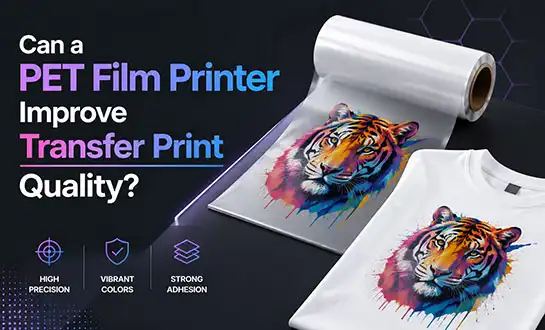
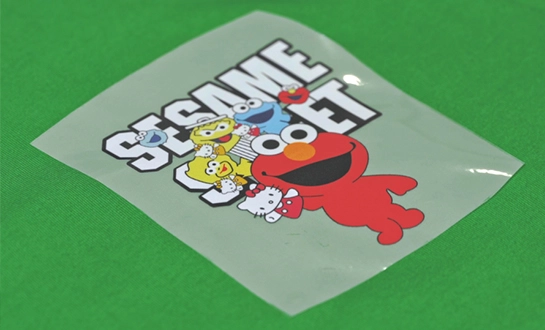
Using aqueous pigment inks and a direct-to-film technology, a mirrored pattern is printed on clear PET film. This is followed by a white ink covering layer. Then, hot-melt TPU glue powder is put on top of the transfer and allowed to dry. Finally, the transfer is heat-pressed onto the clothing. This makes a bright, washable image that sticks to cotton, polyester, nylon, spandex, and blended fabrics without the need for any special treatment first.
Why Compact Format Works for Custom Production?
The A3 DTF printer width (about 300 mm or 12 inches) can print on the chest of a normal T-shirt, the sleeves, and the sides of a bag all at once. That is why it works great for on-demand fulfillment and sample production, where speed-to-sample is more important than roll-width capacity. Impressions Magazine (2023) says that small clothing designers who switched to desktop systems saw a 35–40% drop in the time it took to make one unit compared to screen printing sets for runs of less than 50 pieces.
| Feature | A3 DTF Printer | Traditional Screen Printing |
|---|---|---|
| Minimum order quantity | 1 piece | Usually 24 to 50 pieces |
| Setup cost per design | Near zero | $25 to $80 per color or screen |
| Fabric compatibility | Cotton, nylon, polyester, spandex, and mixes | Mostly materials with a flat weave |
| Color complexity | Full CMYK and gradients | Limits on the number of screens |
| Changeover time | Under 2 minutes | 30 to 90 minutes |
These numbers show why a lot of small companies and new clothing brands are moving to film-based transfer printing as their main way to decorate their products.
How DTF Compares to DTG and Sublimation?
Direct-to-Garment (DTG) printing gives great detail on cotton, but the fabric has to be treated with a gluing agent first, which costs money in terms of time and chemicals, while an A3 DTF printer offers a simpler workflow. When writing white ink on dark clothes, DTG heads can also get clogged up. Direct-to-film gets around both problems because the white layer is taken care of during the film process and there is no need for pre-treatment spraying.
When dye sublimated on 100% polyester, the colors are very good and the finish has no hand-feel. However, it is physically not possible to print on dark fabrics or natural fibers. Transfers produced by an A3 DTF printer stay soft to the touch and can be used on both light and dark substrates with any amount of fiber content. This substrate's versatility alone makes it worth the money for studios and companies that deal with mixed cloth orders.
Choosing the Right Model: FEDAR FD-D300 vs. FD-D302
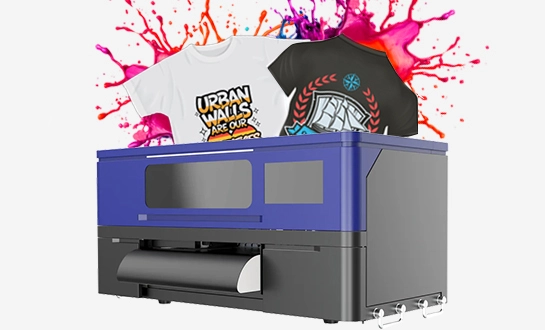
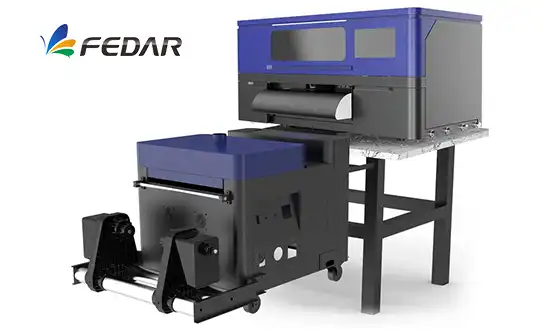
Fedar is a 400-person original equipment manufacturer with a research and development department, quality control staff, and a network of people around the world who help customers after the sale. The two A3 DTF printers listed below use the Epson F1080-A1 printhead. This head is better than older XP600 heads because it has a higher firing frequency, lasts longer, and makes droplets more precisely.
| Specification | FEDAR FD-D300 | FEDAR FD-D302 |
|---|---|---|
| Printhead quantity | 1 × Epson F1080-A1 | 2 × Epson F1080-A1 |
| Print width | 300 mm | 300 mm |
| Print colors | CMYK + White | CMYK + White |
| Max resolution | 1600 DPI | 1600 DPI |
| Max speed (A3) | 10 pages per hour | 31 pages per hour |
| Max speed (A4) | 20 pages per hour | 62 pages per hour |
| Best suited for | Samplers, new businesses, and workshops | Small factories and busy studios |
Here are the main benefits that both types have in common:
- Zero-experience entry point: The workflow is simple enough that operators who have never printed before can use it, with the help of Fedar's technical onboarding materials and training resources.
- High profit margin per order: Because very little ink is used per transfer and very little material is wasted, per-unit costs stay well below retail transfer prices. This protects the margins for both the distributor and the studio.
- No minimum order quantity: There is no minimum order number, so each print job can be for a single item. This means that print-on-demand delivery can be used for business right away.
- Space and energy efficiency: The small desktop chassis takes up almost no floor space and uses a lot less power than wide-format roll systems, which helps small businesses cut costs.
- Low maintenance architecture: The automatic white ink circulation system keeps the titanium dioxide pigment in suspension, which stops the nozzle sedimentation that costs a lot of money when less-well-designed systems break down.
These benefits directly address the problems that equipment dealers and studio managers most often talk about with an A3 DTF printer, such as the high cost of entry, uncertain maintenance costs, and inconsistent sample quality that makes it hard to turn end users.
Maximizing Output Quality and Equipment Longevity
Setting a few important variables correctly is needed to get consistent transfer quality. The hardening temperature should stay between 140°C and 150°C. Transfers that crack or peel after washing are usually caused by not drying long enough. To avoid "oil return" or pinhole flaws, the amount of powder used must match the weight of the ink layer. Fedar suggests that the tip of the A3 DTF printer be checked every day and that the closing station, wiper blade, and encoder strip be cleaned regularly. This is especially important in places where the humidity level is below 40%.
ICC profile compatibility takes care of color management and lets workers match digital copies within the Delta-E limits that are standard in the industry. When the right ink, powder, and film mixture is used, wash fastness testing according to ISO 105-C06 standards always shows Grade 4–5 durability after 50+ wash cycles. This is a standard that procurement managers can show brand customers as proof.
Real Applications Driving Business Growth
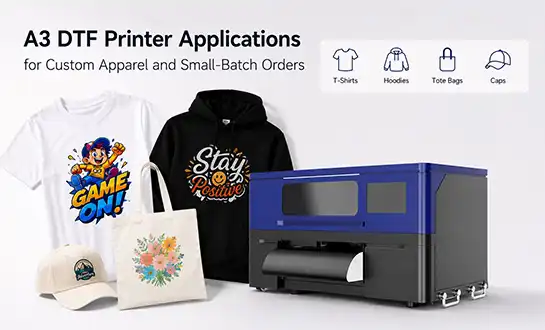
Custom clothing micro-factories use A3 DTF printers to fill personalized orders for e-commerce platforms that only need one item. This gets rid of all the dead stock. Industrial workwear companies use them to mark small batches of uniforms in a way that can stand up to being washed many times in an industrial setting. Decorators of sports gear depend on the high-stretch transfer compatibility to print on spandex and performance polyester without the prints cracking as the fabrics stretch.
In the future, bio-based adhesive powders and automatic powder-shaking units will make it easier for desktop systems to work with systems on the production floor. Brands and distributors that set up direct-to-film workflows are now ready to adopt these upgrades gradually instead of buying all new equipment at once.
Conclusion
With a small direct-to-film printing system like an A3 DTF printer, there are no longer any traditional barriers between an idea and a finished garment. The technology is useful for studios, resellers, and new clothing brands because it doesn't require a minimum order, doesn't cost much to set up, works with a lot of fabrics, and produces results that last through multiple washes. Fedar's FD-D300 and FD-D302 models can do these things thanks to Epson's tried-and-true printhead technology and a factory system designed to help global distribution partners with reliable sample quality and quick technical support.
FAQ
Can A3 DTF transfers adhere to dark-colored fabrics?
Yes. The process puts down a white ink backing layer before the color channels. This means that finished transfers stick well to both light and dark surfaces, like black cotton and navy polyester blends, without the need for a pre-treatment spray.
How does DTF printing compare in cost to screen printing for short runs?
For screen printing, you need an actual screen for each color. Setting up a screen usually costs between $25 and $80. Direct-to-film printing has almost no setup cost per design, which makes it a lot cheaper for runs of less than 30 to 50 pieces.
What routine maintenance does an A3 DTF printer need daily?
A quick nozzle check print, capping station wipe, and encoder strip cleaning can fix most print quality problems on an A3 DTF printer in less than ten minutes. Keeping the humidity level in the air between 40% and 60% lowers film filling mistakes caused by static electricity even more.
How long does a completed transfer last after washing?
When cured properly at 140°C–150°C with suitable ink and TPU powder, transfers meet ISO 105-C06 Grade 4–5 wash fastness, which means they can be washed more than 50 times without losing their color. This was proven by independent tests.
Partner with Fedar — Your Trusted A3 DTF Printer Supplier
Fedar's engineering team and global distribution support are ready to help you set up a small-batch printing business that makes money. Fedar is a direct manufacturer of A3 DTF printers with 400 on-site experts and a track record in the US market. They offer checked print samples, flexible ways to work together, and quick support after the sale. Reach out today at info@tex-printer.com or visit blog.tex-printer.com to request a product demo, sample kit, or distributor pricing package.
References
1. Impressions Magazine — Digital Decorating Technology Trends Report, 2023
2. Printwear & Promotion — DTF vs. DTG: A Practical Comparison for Decorators, 2022
3. Textile World — Advances in Heat Transfer Adhesive Technology for Apparel Applications, 2023
4. Screen Printing Magazine — Cost Analysis: Short-Run Decoration Methods Benchmarked, 2022
5. Specialty Graphic Imaging Association (SGIA) Journal — Wash Fastness Standards and Testing Protocols for Transferred Graphics, 2021
6. Digital Output Magazine — The Rise of Compact DTF Systems in On-Demand Apparel Production, 2024
Michael Zhao
Michael Zhao continuously provides technical trend analysis and equipment application guidance to the industry, dedicated to advancing the industrialization of digital printing as a replacement for traditional screen printing. Achievement: Has published multiple technical analysis articles and provided professional support in equipment selection, process optimization, and fault diagnosis to dozens of printing factories, contributing to the upgrade of the digital printing industry.
We Look Forward to Your Email
Please send us product information that interests you, and we will provide you with one-on-one service.
_1778203196111.png)
Recommended Blog
A3 DTF Printer Applications for Custom Apparel and Small-Batch Orders
What is DTF Printing? A Complete Guide to Direct-to-Film Printing.
_1786522820542.webp)
Industrial Roll to Roll DTF Printer for Continuous Production
Exploring What Is DTF Transfer: A Comprehensive Guide to Direct-to-Film Printing