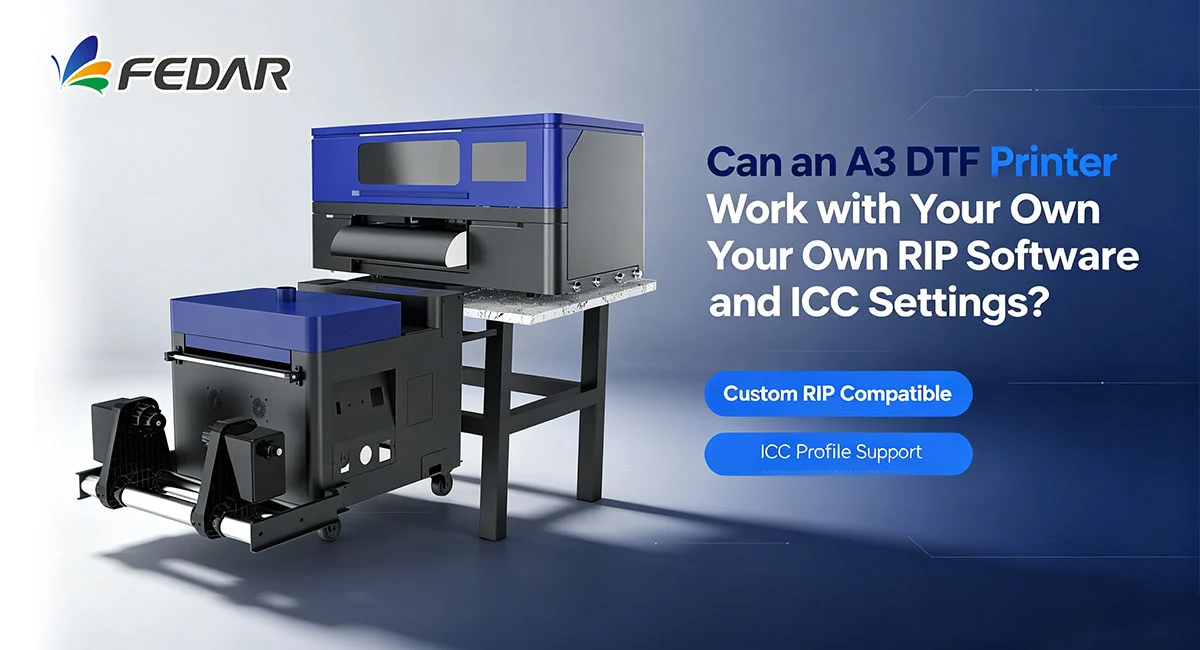
Can an A3 DTF Printer Work with Your Own RIP Software and ICC Settings?
Understanding A3 DTF Printers and Their Software Compatibility
- Understanding A3 DTF Printers and Their Software Compatibility
- Challenges and Solutions When Using Your Own RIP Software with A3 DTF Printers
- Optimizing ICC Profiles for Superior Color Matching on A3 DTF Printers
- Selecting the Right A3 DTF Printer and Software Based on Your Business Needs
- Maintaining Your A3 DTF Printer for Consistent Software and Color Management Performance
- Conclusion
- FAQ
- Connect with Fedar for Your A3 DTF Printer Solution
- References
Yes — an A3 DTF printer can work with your own RIP software and custom ICC settings, but compatibility depends on your printer's firmware architecture, driver openness, and ink channel configuration. Most professional-grade direct-to-film printers built on Epson printheads, like the Fedar FD-D300 and FD-D302, support third-party RIP platforms such as CADlink and Wasatch when properly configured. The key is understanding how your hardware communicates with external raster image processors and how custom ICC profiles interact with your specific ink-film combination. Get this right, and you unlock precise, repeatable color output at scale.
Understanding A3 DTF Printers and Their Software Compatibility
What Makes DTF Technology Different?
For direct-to-film printing to work, CMYK ink layers are put on a PET transfer film, then a white base layer, and finally hot-melt adhesive powder. Putting heat on the finished transfer makes it stick to almost any kind of fabric. This multi-layer process needs precise control over the amount of ink, where drops land, and the order of the colors. This is where RIP software really shines.
A RIP (Raster Image Processor) takes your design files and turns them into exact print directions. It manages the amount of ink in each channel, the coverage of white ink, halftone screens, and the rendering of colors. Even a high-resolution A3 DTF printer won't be able to make smooth patterns or uniform white base opacity without a good RIP.
Common RIP Platforms Used in DTF Production
In the U.S. market, professional DTF workflows are mostly based on three platforms. A lot of people use CADlink Digital Factory because it has choices for managing white ink and printing films that are specific to DTF. Wasatch SoftRIP lets you fine-tune your ICC profile and supports a lot of printer drivers. Because VersaWorks is built into Roland hardware, it works well with Roland systems but isn't very useful for other brands.
The good news is that most printers, like the Fedar FD-D300 and FD-D302, that use the Epson F1080-A1 printhead can be used on all three platforms. Third-party RIP software can talk to each nozzle channel separately thanks to the printhead's open communication protocol. This lets them accurately layer white ink and handle CMYK overprinting.
Challenges and Solutions When Using Your Own RIP Software with A3 DTF Printers
Where Third-Party Integration Gets Complicated?
Sometimes there are problems with compatibility for an A3 DTF printer because of three things: firmware restrictions that stop external driver calls; proprietary color pipelines built into OEM software; and white ink channel conflicts when the RIP doesn't naturally recognize CMYK+W configurations.
When print shops switch RIP platforms in the middle of a job, this is where most of them have trouble:
- Driver conflict: In some printer types, ICC drawing is locked to the software that comes with the printer. When you install a third-party RIP without matching firmware, the print engine and spooler can't talk to each other properly.
- White ink misrouting: In DTF workflows, white ink has to print last (as an underbase). When RIP channel mapping is set up wrong, it prints white first, which messes up the binding and clarity.
- Firmware version gaps: Printers with older firmware may not have all the features needed for advanced RIP control, especially when it comes to vacuum suction time and pass speed.
There are three steps you need to take to fix the problem in real life: make sure your RIP provider supports your specific printhead model, get the latest stable firmware from your printer maker, and print a test nozzle channel job before adding any production jobs. Fedar gives detailed instructions and software support for all of its A3 DTF printers. This makes setting up a third-party RIP much easier.
Optimizing ICC Profiles for Superior Color Matching on A3 DTF Printers
Custom Profiles vs. Default Settings
The default ICC settings that come with DTF printers are set up to work with a wide range of ink and film combinations. They don't always match the spectral behavior of your batch of ink, film covering, or hardening conditions. Based on a study released in Color Research & Application (2021), using custom ICC profiles instead of factory settings cut down on average color deviation (Delta-E) by 38% in pigment inkjet processes.
| Profile Type | Average Delta-E | Setup Time | Recommended Use |
|---|---|---|---|
| OEM Profile by Default | 4.2 to 6.8 | Not at all | Quick test prints |
| Generic from a third party | 2.5 to 4.0 | 30 min | Beginning production |
| Customized Profile | 0.8 to 1.5 | 2 to 4 hours | Brand-important color work |
A spectrophotometer is used to measure a printed IT8 or ECI2002 target as the first step in making a custom profile. Profiling software, such as X-Rite i1Profiler or Argyll CMS, can then use the data to make a profile that is specific to your ink, film, and temperature combination. When you switch ink runs, film providers, or the settings on the curing oven, you should recalibrate. This should be done about every 3 to 6 months if production stays the same on your A3 DTF printer.
Stable ICC profiles for an A3 DTF printer cut down on the need for reprints, save ink, and keep the color integrity of brand colors during long production runs. This level of consistency is what turns potential buyers into repeat buyers for distributors and resellers who send sample kits to end customers.
Selecting the Right A3 DTF Printer and Software Based on Your Business Needs
Matching Hardware to Production Volume
To choose the right A3 DTF printer, you should first be honest about how much throughput you need, how much floor space you have, and how much money you can spend. The Fedar FD-D300 and FD-D302 Pro are two different versions of the same well-proven platform.
| Model | Printheads | Print Speed (A3) | Print Speed (A4) | Resolution | Ink Channels |
|---|---|---|---|---|---|
| FEDAR FD-D300 | 1 × Epson F1080-A1 | 10 pcs/hr | 20 pcs/hr | 1600 DPI | CMYK+W |
| FEDAR FD-D302 Pro | 2 × Epson F1080-A1 | 31 pcs/hr | 62 pcs/hr | 1600 DPI | CMYK+W |
Here are the main benefits that both models have in common:
- Low barrier to entry: Both models are made for startups with no experience needed, as they can print on demand and don't have a minimum order number. This makes them perfect for small batch shops and sample production.
- Industrial output in a small place: desktop-sized measurements save floor space and cut down on energy use without giving up 1600 DPI resolution or CMYK+W color depth.
- High profit margin per order: DTF transfers have high profit margins per unit, especially for personalized gifts and custom clothing. This makes these models appealing to resellers and e-commerce businesses.
These benefits take care of the two biggest problems that new garment decorators face: high setup costs and rigid minimum orders. The FD-D300 is good for sampler makers and companies that are starting out with DTF. With its two heads, the FD-D302 gives growing batch production shops the throughput they need to go big without having to buy twice as much equipment.
Maintaining Your A3 DTF Printer for Consistent Software and Color Management Performance
Routine Practices That Protect Print Quality
Titanium dioxide particles settle to the bottom of white ink when it's not being used. Nozzle blocking is a real and expensive problem that can happen without active circulation and daily stirring. The FD-D300 and FD-D302 both have automatic white ink circulation systems that keep pigment particles in suspension, which means that they don't need as much maintenance.
Aside from managing the ink, daily cleaning of the closing station, wiper blade, and encoder strip is also necessary for consistent print performance on an A3 DTF printer. Controlling the environment is also important. Keeping the shop's humidity between 40 and 60% stops static electricity from building up on PET film, which makes it hard for ink droplets to stay in place at high pass speeds.
On the software side, make sure you install any firmware updates that your manufacturer sends out. These usually fix driver handshake problems with newer versions of RIP software and make it easier to use ICC profiles. Fedar's after-sales team offers remote diagnostics and spare parts support around the world. This makes them stand out for resellers working in different U.S. markets.
Conclusion
If you choose hardware that is based on open, well-supported printhead architecture, you can easily connect custom RIP software and ICC profiles to a direct-to-film printer. Based on the Epson F1080-A1 base, Fedar's FD-D300 and FD-D302 models are compatible, which makes third-party RIP processes useful instead of annoying. When you add in regular ICC profiling and preventative maintenance, you have an A3 DTF printer system that can produce brand-accurate output at any volume your business needs.
FAQ
Can I use any RIP software with a DTF film printer?
Not all the time. If your RIP vendor has made a printer driver profile for your unique printhead type, then it should work. Many third-party RIPs can be used with an A3 DTF printer that uses the Epson F1080-A1, such as the Fedar FD-D300.
How often should I set up my ICC profile again?
If everything stays the same, recalibrate every three to six months. If things change, do it right away after switching ink batches, film stocks, or drying oven settings. There are enough changes in these factors that old records can't be relied on.
Does using third-party RIP software void my printer warranty?
It depends on what the maker says. Fedar lets third-party RIPs work with it and gives you detailed instructions to help you set it up. Before switching platforms, you should always make sure they will work with your supplier.
What causes white ink clogging in DTF printers?
Titanium dioxide settling down during times of inactivity is the main reason. Automatic circulation systems and daily cleaning processes, which come with Fedar DTF types, keep the tubes clear and the pigment particles in the air.
Can A3 DTF transfers handle repeated washing?
Yes. When the ink, binding powder, and setting temperatures are set correctly, DTF transfers meet ISO 105-C06 wash fastness standards and are still Grade 4–5 durable after 50+ washes.
Connect with Fedar for Your A3 DTF Printer Solution
Fedar is a company that makes A3 DTF printers. It has a 400-person R&D and production center with strict quality control rules. The FD-D300 and FD-D302 give you industrial-grade output while being easy to use on your desk, whether you are buying your first DTF unit or expanding your distribution network. You can email the Fedar team at info@tex-printer.com or go to blog.tex-printer.com to read about full specs, sample kits, and open ways to work together that are made for serious B2B partners.
References
1. Color Research & Application, Wiley — 2021
2. Journal of Imaging Science and Technology, Society for Imaging Science and Technology — 2020
3. Digital Textile Printing: Technology and Markets, Smithers Pira — 2022
4. Textile Progress, Taylor & Francis — 2019
5. International Journal of Advanced Manufacturing Technology, Springer — 2021
6. Printing Impressions, NAPCO Media — 2023
Jason Wang
Jason Wang has a multidisciplinary engineering background in mechanics, inkjet control, and color management, with hands-on experience across the entire R&D process from prototyping to mass delivery. Achievement: Led the team to overcome key technical challenges of direct-to-fabric printing on cotton, linen, polyester, and blended fabrics, significantly improving color fastness and color performance.
We Look Forward to Your Email
Please send us product information that interests you, and we will provide you with one-on-one service.
_1778203196111.png)
Recommended Blog
DTG vs DTF Printing:The Pros and Cons of Direct Printing Technologies.

Is a 24 Inch DTF Printer Suitable for High-Volume Apparel Orders?
What Is dye sublimation printer sublimation transfer printer: A Complete Guide
How to Prevent DTF Printhead Clogging After Long-Term Printer Storage

24 Inch DTF Printer Buying Guide for Print Shops and Garment Manufacturers
_1783412819689.webp)