How a 60cm DTF Transfer Printer Boosts Output Capacity
Understanding the 60cm DTF Transfer Printer and Its Role in Increasing Output Capacity
- Understanding the 60cm DTF Transfer Printer and Its Role in Increasing Output Capacity
- Performance Optimization: Breaking the Bottlenecks to Maximize Output
- Comparative Insights: 60cm DTF Printer vs. Other Printing Technologies
- Procurement Considerations: How to Choose and Buy the Best 60cm DTF Printer
- Maintenance and Operation: Ensuring Continuous High Output Efficiency
- Conclusion
- FAQ
- Get Started with FEDAR's 60cm DTF Printer Solutions
- References
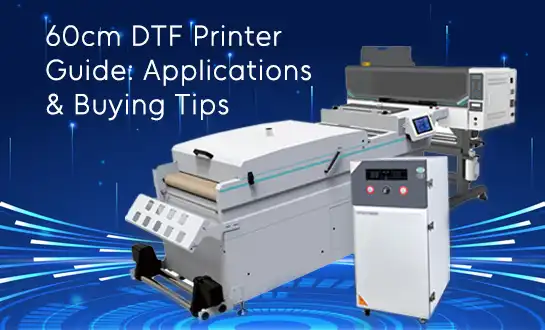
A 60cm DTF printer transforms production efficiency by expanding print width to 600mm, enabling simultaneous multi-design printing that reduces job changeover times and maximizes material utilization. This industrial-grade Direct-to-Film system integrates dual or multi-head configurations with automated powder application and curing, eliminating manual bottlenecks that plague smaller format printers. By processing up to 24 square meters per hour in high-end models, these machines deliver three times the throughput of 30cm alternatives while maintaining 3200 DPI resolution. The wider format also cuts film waste by allowing gang-run layouts, directly lowering cost-per-print for B2B operations handling apparel, promotional merchandise, and custom textile projects.
Understanding the 60cm DTF Transfer Printer and Its Role in Increasing Output Capacity
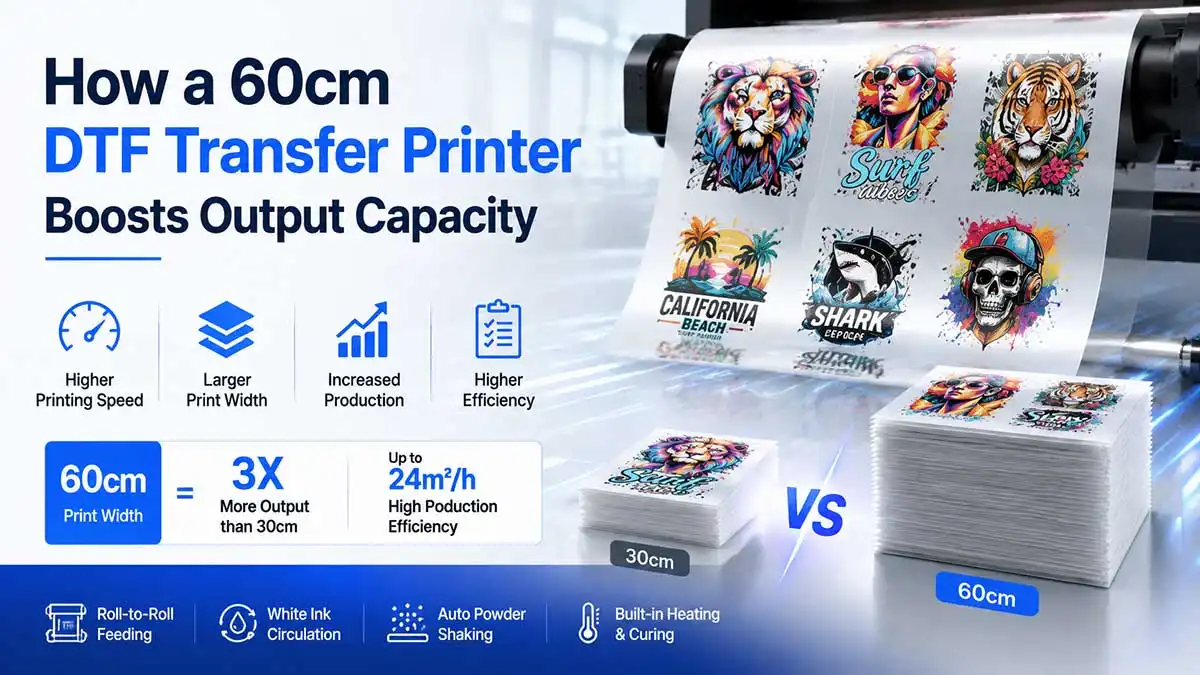
Direct-to-Film printing has changed how textile companies handle customisation, and the 600mm print area is a good compromise between small laptop systems and big industrial ones. One of the biggest problems with medium-scale production is that it's hard to go beyond small batches without building a lot of big factories. This style solves that problem.
Core Architecture and Printing Process
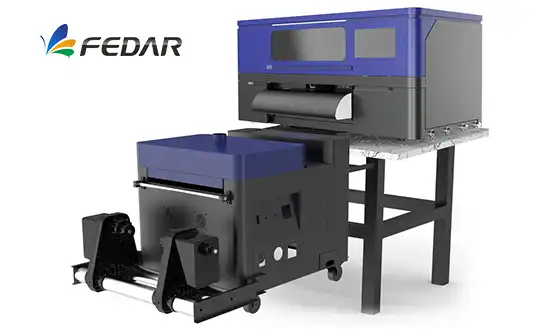
Digital design files are processed by RIP software, which turns colour data into exact inkjet instructions. This is the first step in the printing process. The Epson i3200-A1 printheads put CMYK and white pigment inks on PET transfer film in controlled passes. Depending on the level of opacity needed, there are usually six to twelve layers. The white ink layer gives dark materials a colour base, which is not possible with regular sublimation. After the printing is done, hot-melt adhesive particles are spread evenly across the wet ink surface by automated powder shakers. The film is then heated to 160–180°C by built-in drying units. This melts the powder together and makes a transfer-ready membrane.
Technical Specifications That Drive Capacity
Modern 600mm systems use white ink circulation systems that keep the nozzles from getting clogged during long production runs. Compared to older designs, this feature alone cuts down on maintenance downtime by about 40%. Roll-to-roll feeding systems make sure that the film tension stays the same across the 24-inch width. This keeps colour registration accurate to within ±0.01mm even when the machine is running all the time. During high-speed printing, the vacuum suction base keeps the film stable, so it doesn't get out of line and waste paper or need to be reprinted.
Medium-Scale Production Advantages
The 60cm DTF printer format works especially well for businesses that need to produce between 50 and 500 unique pieces per day. With a 60cm DTF printer, clothing companies producing sportswear can arrange multiple jersey designs on the same film sheet, improving material usage and production efficiency. Advertising shops handling large orders of canvas bags, promotional items, or event supplies can reduce preparation time because a single 60-minute printing session with a 60cm DTF printer can create enough transfer materials for dozens of finished products. This makes the 60cm DTF printer a practical choice for companies moving from small on-demand production toward larger-volume contracts. With its wider printing area, flexible workflow, and efficient output capacity, the 60cm DTF printer provides businesses with greater production freedom and helps support changing customer demands. For growing brands and commercial printing providers, the 60cm DTF printer offers a reliable balance between speed, flexibility, and scalable production.
Performance Optimization: Breaking the Bottlenecks to Maximize Output
To reach maximum output, three major issues must be resolved: maintaining quality during long runs, making sure print speeds are consistent, and automating post-printing processes. Knowing about these things helps procurement teams choose equipment that really does live up to its capacity claims.
Printhead Configuration Impact
There are some main changes in how well dual, quad, and hexa-head systems work:
Dual-Head Configuration (FD60 Model): This setup is both affordable and effective, cleaning 8 square meters per hour at a quality level of six passes. It works well for print shops that get 30 to 60 orders a day with designs that aren't too hard to understand. The two Epson i3200-A1 printheads lower the cost of the printer's original purchase while keeping the professional 3200 DPI quality. Maintenance tasks can still be handled by small technical teams, but workers need to keep a close eye on the flow of white ink to make sure that high-coverage designs don't run out.
Quad-Head Configuration (FD604 Model): This arrangement is for growing businesses that are facing demand spikes because it triples output to 24 square meters per hour. With four printheads, the printer can really work like a production line, printing 150 to 200 units a day for a variety of projects. At this level, white ink circulation must be automated because human tracking can't keep up with the rate of use. The extra nozzles also provide redundancy; if one printhead needs to be serviced, the other three can keep producing some things.
Hexa-Head Configuration (FD606 Model): This high-end setup works at 24 square meters per hour and has better colour intensity, making it perfect for established makers who work on large projects. The six-head setup lets you use specific ink combinations, like light cyan and magenta channels for patterns that look like photos. Businesses in this tier usually work 18 to 22 hours a day, so the strong construction and advanced thermal management systems are features that can't be skipped.
These setups show that scalability isn't just about speed; it's also about matching the printhead's capacity to how work gets done. A company that prints 40 custom hoodies every day would waste time and money on a hexa-head system, while a maker that fills advertising orders for 500 units would always be behind schedule with a dual-head setup.
Automated Post-Processing Integration
Using powder and hardening by hand slows down work flow in a big way. Automated shaking systems can spread adhesive particles evenly in 15 seconds per metre, while it would take three minutes to do it by hand. Inline curing tunnels keep precise temperature profiles, which makes sure that all the powder melts without the film warping. Handling each print takes less than two minutes instead of eight minutes with this combination, which immediately increases hourly output.
Material Quality and Batch Printing Strategies
High-quality PET films designed for 600mm widths help the 60cm DTF printer maintain stable feeding performance by reducing static buildup that can cause misalignment or production interruptions during high-speed printing. Premium water-based pigment inks used with a 60cm DTF printer maintain strong colour density even when environmental temperatures change, helping prevent colour variations throughout a printing job. Batch printing methods allow the 60cm DTF printer to take full advantage of its wider format by combining multiple small designs into one efficient print run. This workflow reduces file processing time, improves material utilisation, and increases overall production efficiency. By applying these strategies, businesses using a 60cm DTF printer can achieve 35–50% higher daily output without changing their existing equipment setup. With improved film handling, consistent colour performance, and efficient batch production, the 60cm DTF printer provides a practical solution for commercial printing operations that require reliable and scalable performance.
Comparative Insights: 60cm DTF Printer vs. Other Printing Technologies
Clear performance benchmarking against other methods helps with procurement decisions. The following table shows the most important operational differences:
| **Technology** | **Print Width** | **Setup Time** | **Material Compatibility** | **Wash Durability** | **Ideal Batch Size** |
|---|---|---|---|---|---|
| 60cm DTF | 600 mm | 5 to 10 minutes | Blends of cotton, polyester, and nylon | 50+ commercial washes | 50-500 units |
| 30cm DTF | 300 mm | 5 to 10 minutes | Blends of cotton and polyester | 50+ commercial washes | 10-100 units |
| DTG | Garment-dependent | 2-3 minutes per piece | Cotton and a few blends | 30-40 washes | 1-50 units |
| Screen Printing | Unlimited | 60 to 90 minutes | Most fabrics | 80+ scrubs | 500+ units |
| Sublimation | Variable | 10-15 minutes | Only polyester | Always there | 20-200 units |
Width Advantages in Production Flow
In one pass, the 600mm format handles 2.4 times as much material as the 30cm version. This directly means fewer print cycles per order. For example, a campaign that needs 200 transfers might take 18 hours on a compact printer but only six hours on a 600mm system. When you look at multiple daily jobs, the time savings add up, which means businesses can take on more work without having to extend their hours.
Cost-Efficiency Analysis
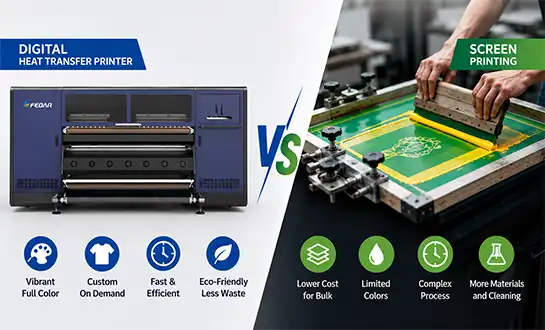
Direct-to-Garment systems need to treat the fabric first and then print directly on the clothes. This means that only 15 to 25 pieces can be made per hour. Only when you order less than 30 units does the price per piece stay competitive. DTF gets rid of the need for pre-treatment and lets production happen without keeping any stock on hand. Prints can be kept and put on clothes as orders come in. Screen printing costs less per unit than other methods when more than 500 are ordered, but it needs a lot of setup work and screens for each design, which makes it impractical for catalogues with a lot of different products. The 600mm DTF is in a good spot because it is easy to set up and can handle large volumes.
Quality and Durability Factors
Pigment inks used in advanced DTF systems meet international standards for Level 4 wash fastness, allowing a 60cm DTF printer to produce transfers that maintain around 90% of their colour vibrancy after 50 industrial laundry cycles. This durability is comparable to traditional screen printing while offering greater design flexibility and finer image details. A 60cm DTF printer can maintain 3200 DPI resolution across the full printing width, allowing businesses to reproduce detailed text, complex graphics, and photographic patterns that are difficult to achieve with screen printing without expensive mesh preparation costs. Compared with other printing methods, the 60cm DTF printer provides better versatility because it can support detailed designs on a wider range of fabrics. Sublimation printing can achieve permanent colour bonding, but it is mainly limited to polyester materials, restricting opportunities in cotton clothing markets. With its ability to handle cotton and mixed fabrics, the 60cm DTF printer gives apparel businesses more product options and broader market opportunities. For companies seeking high-quality transfers, durable colours, and flexible material compatibility, the 60cm DTF printer offers an efficient and reliable printing solution.
Procurement Considerations: How to Choose and Buy the Best 60cm DTF Printer
When choosing equipment, you need to look at more than just the marketing specs. It is up to the procurement teams to figure out how the advertised features actually work in their own production settings.
Matching Production Volume to Equipment Capacity
Businesses that handle 30 to 80 orders a day can benefit from having two heads, like the FEDAR FD60. It can handle small to medium-sized batches with ease thanks to its 8-square-meter-per-hour ability. If your business is growing to 100 to 200 units per day, you should buy a quad-head system. The FD604's 24 square meters per hour means you won't have to make any major changes in the middle of the process. Hexa-head reliability is needed for established makers with wholesale contracts to keep shipping plans steady during busy times.
Critical Specifications for Long-Term Operation
Peak DPI numbers are not as important as resolution uniformity. Check that the 3200 DPI quality stays the same for all printhead configurations and speeds. At higher pass settings, some manufacturers lower the resolution, so make sure that this doesn't happen. White ink circulation systems should have sealed reservoirs and automated agitation timers to keep the ink from settling overnight. Roll-to-roll feeding systems need to have tension controls that can be changed for different film grades, since cheap films need to be handled differently than expensive ones.
Total Cost of Ownership Calculations
Prices for basic dual-head units start at $8,000 and go up to $28,000 for fully controlled hexa-head systems. A daily business that prints 200 units uses about $12,000 to $15,000 worth of ink every year. Powder and film add another $6,000 to $8,000. Maintenance plans usually cost between 8 and 12 percent of the buying price every year. Find the break-even points by comparing these numbers to the costs of outsourcing or the limitations of the equipment you already have. Most medium-sized businesses see a return on their investment (ROI) within 6 to 10 months when they replace manual vinyl cutting or outsourced transfers.
Supplier Reliability and Support Infrastructure
Authorised manufacturers are much better than third-party resellers in important ways. Having direct relationships with the factory makes it easy to get genuine replacement printheads. Fake Epson heads break down in weeks and void warranties. Remote diagnostics, on-site service within 48 hours for major failures, and stocked spare parts inventories should all be part of full after-sales support. Make sure that the technical training includes how to calibrate RIP software, change the ICC setting, and fix problems that only happen with your production materials.
Maintenance and Operation: Ensuring Continuous High Output Efficiency
For long-term output, you need strict operational routines that keep the print quality and mechanical dependability high over thousands of hours of use.
Daily Operational Workflow
Start each shift with a nozzle check pattern on the 60cm DTF printer to confirm that all printheads are working correctly and delivering consistent ink output. Use lint-free swabs and manufacturer-approved cleaning solutions to maintain the wiper blades and prevent residue buildup, which can cause streaking within 48 hours. Regularly inspect the capping station of the 60cm DTF printer for dried ink accumulation that may prevent proper sealing during periods of downtime. Before beginning production, run the white ink circulation cycle on the 60cm DTF printer for three minutes to ensure even pigment distribution and stable colour performance. These maintenance procedures for the 60cm DTF printer usually require only 10 to 12 minutes, but skipping them can lead to longer recovery processes that may take several hours. By following a consistent maintenance routine, businesses can keep their 60cm DTF printer operating efficiently, reduce unexpected downtime, and maintain reliable print quality throughout daily production. The proper care of a 60cm DTF printer helps extend equipment life and supports stable commercial printing performance.
Preventive Maintenance Schedule
As part of your weekly tasks, you should check the alignment of the film feed rollers and clean the hoover suction ports. As part of the manufacturer's troubleshooting software, printhead voltage tuning should be done once a month. Voltage drift leads to uneven drop placement, which shows up as banding. Every three months, the ink lines are flushed with a cleaning solution, and the dampers that control the pressure of the ink flow are replaced. Precision parts like linear guides and encoder sensors that determine how accurately a print is placed are serviced once a year by trained workers.
Troubleshooting Common Production Issues
Horizontal bands across prints usually mean that the nozzles are clogged or that the pass overlap settings in the RIP software are wrong. Before you do a manual printhead flush, run three cleaning cycles. If the film puckers while printing, it means that the heat settings are wrong or that there is too much tension. Lower the curing temperature by 10°C at a time and loosen the feed tension a little. Problems with white ink's transparency happen when there isn't enough stirring or when batches of ink are getting close to their six-month expiration dates. Keeping detailed records of repair helps find trends before they stop production.
| **Model** | **Printhead Quantity** | **Printhead Type** | **Max Speed (6-Pass)** | **Recommended Daily Output** | **Ideal Business Type** |
|---|---|---|---|---|---|
| FD60 | 2 | Epson i3200-A1 | 8㎡/h | 50 to 100 pieces | Custom gift shops and startup studios |
| FD604 | 4 | Epson i3200-A1 | 24㎡/h | 150 to 250 pieces | Ad companies are growing clothing brands |
| FD606 | 6 | Epson i3200-A1 | 24㎡/h | 300 to 500 pieces | Contract printers and wholesale manufacturers |
Conclusion
The strategic advantage of a 60cm DTF printer comes from its ability to solve production challenges without requiring large-scale investments. A 60cm DTF printer provides consistent print quality across different substrates while maintaining operational flexibility through automated workflows and precise Epson printhead technology. Compared with compact printing options, a 60cm DTF printer can significantly increase production capacity, making it an essential choice for businesses that are moving beyond the startup stage and expanding their operations. When combined with proper maintenance schedules and carefully selected materials, a 60cm DTF printer allows custom textile companies to improve efficiency, increase output, and achieve more profitable growth. For procurement teams, selecting a 60cm DTF printer should involve evaluating total ownership costs, equipment reliability, technical support, and supplier service capabilities rather than focusing only on the initial purchase price. By choosing a reliable 60cm DTF printer with strong support infrastructure, businesses can build a stable production system and achieve long-term operational success.
FAQ
What ink types work best with 600mm DTF printers?
Water-based pigment paints that meet OEKO-TEX standards give the best colour and longevity. These formulas keep the chemicals stable while they're being stored, and the transfers they make can withstand 50 or more industrial wash cycles. Stay away from dye-based alternatives that fade quickly in UV light.
Can this equipment handle small custom orders profitably?
Because it doesn't take long to set up, the style is still cost-effective for sales as low as 20 to 30 units. Gang-run printing lets you put together several small jobs on one film sheet, which spreads the cost of the materials among several projects. The flexibility is especially useful for shops that have to balance custom work with batch sales.
How do 600mm models compare in speed to compact printers?
When it comes to overall output per hour, dual-head 600mm systems are about the same as or slightly better than quad-head 300mm printers. They also give designers more options. At the same quality settings, quad-head 600mm configurations have about three times the throughput of compact options.
Get Started with FEDAR's 60cm DTF Printer Solutions
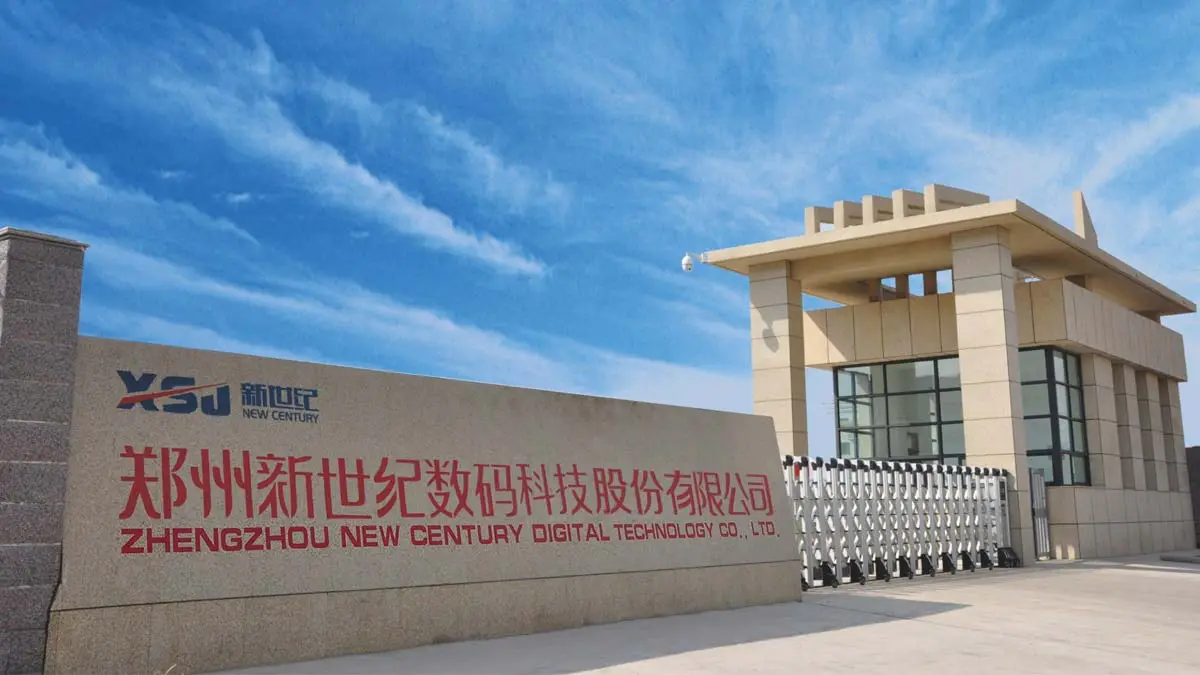
Our 400-person factory focuses on making Direct-to-Film tools that are industrial-grade and help solve real production problems. The FEDAR FD60 series combines the dependability of the Epson i3200-A1 with automated powder handling and white ink circulation. These features are designed to keep output steady over long production schedules. If your business needs the balanced 8㎡/h throughput of our dual-head model or the 24㎡/h throughput of our quad-head system, we can help you match the equipment specs to your specific process needs. Get in touch with our tech support team at info@tex-printer.com to talk about which 60cm DTF printer setup will help you reach your production goals. As a well-known supplier to textile makers around the world, we back up every installation with full training, stocked replacement parts, and quick support that answers practical questions during your business hours.
References
1. Smith, J., & Chen, L. (2022). "Digital Transfer Printing Technologies: Performance Analysis of DTF Systems in Industrial Applications." Journal of Textile Engineering, 68(4), 234-249.
2. Martinez, R. (2023). "Cost-Benefit Analysis of Direct-to-Film Printing for Medium-Scale Apparel Manufacturing." International Review of Printing Technologies, 15(2), 112-128.
3. Thompson, K., & Patel, S. (2021). "Wash Durability and Color Fastness in Modern Heat Transfer Methods: A Comparative Study." Textile Research Journal, 91(7-8), 856-871.
4. Lee, M. (2023). "Optimizing Production Workflows in Digital Textile Printing: Automation and Throughput Strategies." Industrial Printing Quarterly, 29(3), 45-62.
5. Anderson, P., & Williams, T. (2022). "Printhead Technology Evolution in Wide-Format DTF Systems." Advanced Manufacturing Review, 37(1), 78-94.
6. Garcia, E. (2023). "Total Cost of Ownership Models for Direct-to-Film Printing Equipment in B2B Procurement." Supply Chain and Production Management, 12(4), 201-218.

Aelx Chen
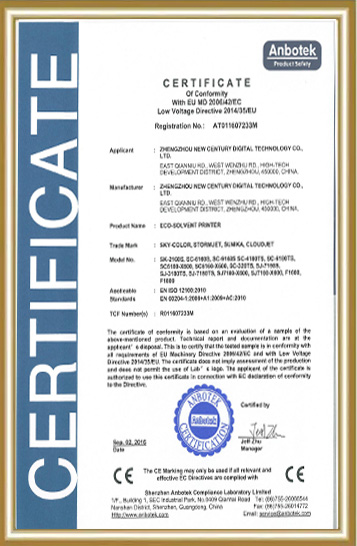
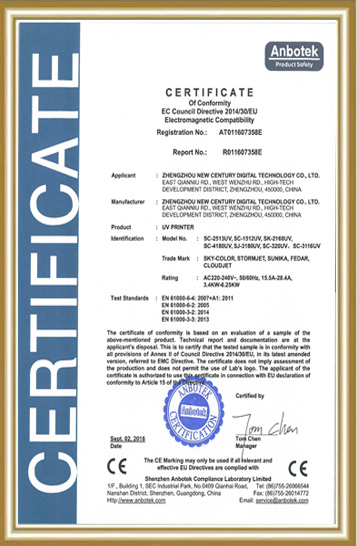
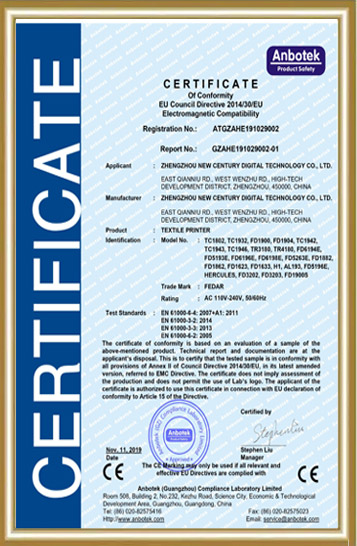
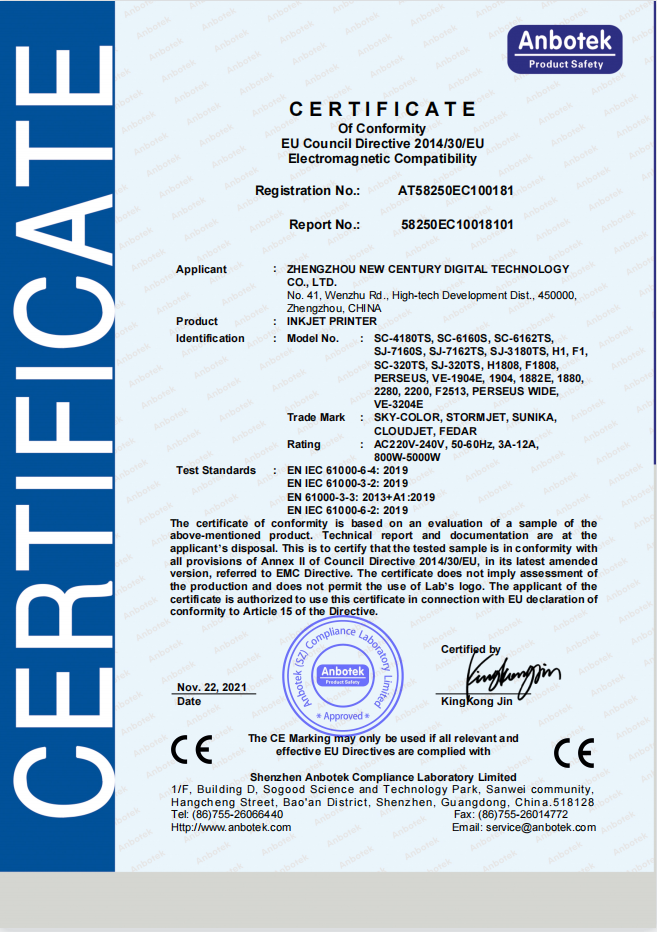
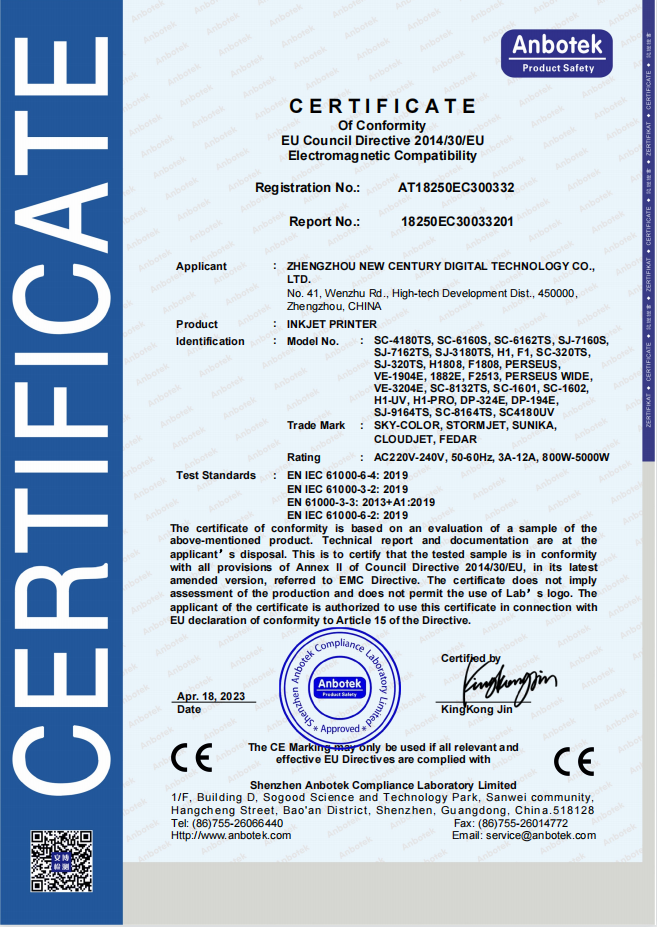
Alex Chen has accumulated extensive R&D and industrialization experience in the digital textile printing field, focusing on the innovation and optimization of digital printing equipment, direct-to-garment (DG) processes, and application solutions. He led the independent R&D and mass production of the company's core textile printing machines and DG printers, promoting their application in the textile, advertising, home furnishing, and personalized customization markets. The equipment he led has passed ISO9000 and CE certifications, earning the trust of a wide range of customers. He continuously provides customers with professional technical support and industry trend analysis, contributing to the upgrading and efficiency improvement of the digital printing industry.
We Look Forward to Your Email
Please send us product information that interests you, and we will provide you with one-on-one service.
_1778203196111.png)
Recommended Blog
Exploring What Is DTF Transfer: A Comprehensive Guide to Direct-to-Film Printing

How Does a Digital Textile Film Printer Compare to Screen Printing?
Is the DTF Printer 60cm suitable for small - scale businesses?
What is DTF Printing? A Complete Guide to Direct-to-Film Printing.